
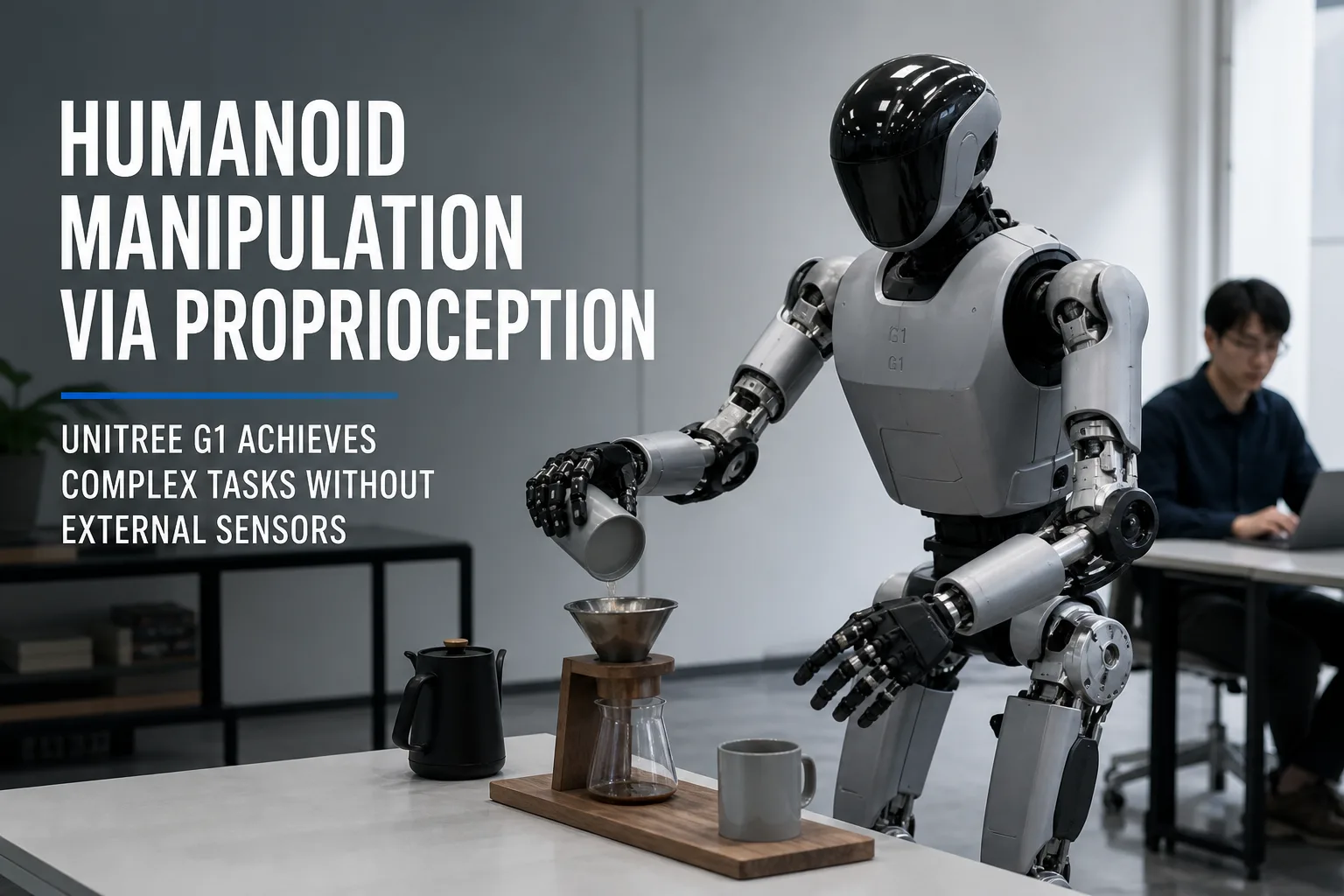
Researchers have unveiled a breakthrough in embodied AI: a Unitree G1 humanoid robot performing complex manipulation tasks using solely joint encoder feedback, without relying on cameras or tactile sensors. It leverages compliant contact with the environment to infer object state and position through proprioceptive history alone, marking a significant step forward in low-sensor physical AI systems.
Sensorless Humanoid Dexterity
The innovation lies in enabling a humanoid robot to infer tactile details from proprioceptive feedback—using the robot’s internal joint encoders to sense and adapt to environmental interactions. This method opens a path toward reducing reliance on external sensing hardware, simplifying design and potentially lowering costs.
Implications for Robotics Design and Deployment
By relying on internal senses, robots can become more robust and easier to deploy in environments where cameras or touch sensors may fail—such as extreme lighting or dusty conditions. This approach could also reduce hardware complexity, power consumption, and total system cost.
Context Within Physical AI Trends
The development aligns with a broader trend toward embodied AI systems that learn through direct physical interaction rather than relying on high-bandwidth perception modules. It represents a step toward more resilient, adaptive robots capable of sophisticated tasks in real-world settings.
Takeaway: Proprioception-only control in humanoid robots promises simpler, more robust physical AI systems — a durable alternative for environments unfriendly to traditional sensing methods.

