
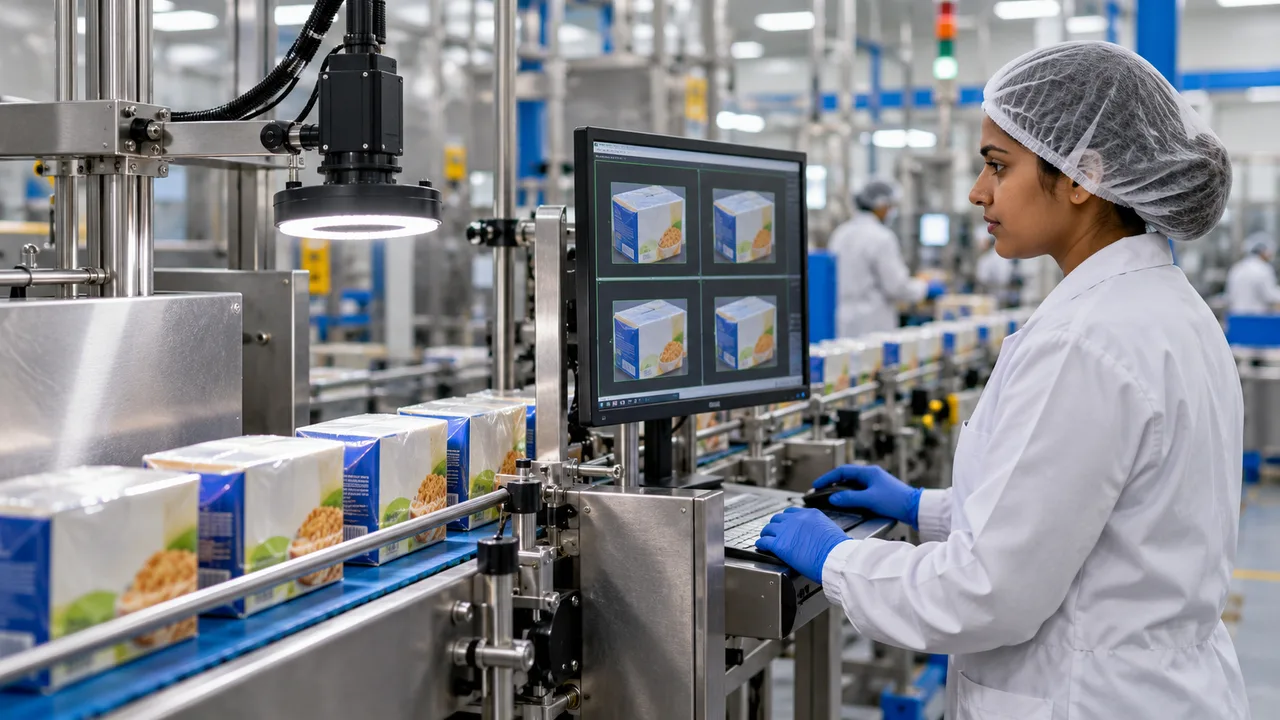
Start with the problem.
An inspection model must work at the line's real speed and under its changing lighting, product and packaging conditions. This study proposes a bounded defect-detection pilot with a human decision path and a safe response to uncertain results.
A practical way forward.
Repeatable image capture
Select camera placement, lighting and triggers before training. Record the product and batch context for each inspection.
Defect evaluation
Build a labelled image set that includes acceptable variation and genuine defects, then evaluate on separate batches.
Operational integration
Route uncertain items to review and connect inspection summaries to production records. Any automatic reject mechanism requires its own engineering validation.
The workflow, simply.
- Capture image
- Model inspection
- Review or controlled action
- Batch reporting
Architecture to consider.
Fixed cameras and lighting provide consistent inputs at the inspection station.
An edge inference service returns a result and confidence within the required latency.
A review application and production adapter preserve image references, decisions and batch history.
How success should be tested.
- Measure false rejects and missed defects on separate production batches.
- Test latency, camera faults and behaviour when the model is unavailable.
- Review changes in lighting, material or packaging before reusing the model.
Useful things to know.
Can an AI camera replace all manual quality checks?
No such claim is made. A camera sees only the defects represented by its view, data and validation. Staff review and the existing quality process remain part of the pilot design.
What is needed before training a production inspection model?
A stable capture setup, permitted labelled examples, an agreed defect taxonomy and independent test batches. The business must also define acceptable missed-defect and false-reject rates.